
PUBLISHING AND DESIGN FOR NATURE AND PEOPLES OF THE EARTH
Editorial y diseño por la naturaleza y los pueblos de la tierra
P A N G A E A
The Publisher
PUBLISHING AND DESIGN FOR NATURE AND PEOPLES OF THE EARTH
Editorial y diseño por la naturaleza y los pueblos de la tierra
THE MIDWEST BOOK REVIEW
October 1998Other companies have excelled in publishing nature-oriented guides: what differentiates these [books by PANGAEA] from others is a Spanish/English format and intense color photos throughout which provide a rich multicultural travel exploration accessible to both Spanish speakers and those touring from the outside. Alfonso Silva Lee's Natural Puerto Rico provides an in-depth focus on the wildlife of the island, describing the natural history of insects, reptiles and birds. Marcelo Beccaceci's Natural Patagonia achieves the same for Patagonia. While these are as much science as travel guides, they will especially enrich the tours of any outdoors-oriented adventurer, providing fine natural history insights to accompany any traveler's journey.
PANGAEA is an independent publishing house founded in 1991 to focus on the natural history of the Earth and on her people.
ABOUT PANGAEA'S LOGO BAR
Our logo bar design includes a representation of club moss, one of the earliest plant forms on Earth, dating from the age of the supercontinent Pangaea nearly 225 million years ago. The carbon remains of the early mosses, which grew over 100 feet high, have been compressed for many millions of years and form our present day coal reserves.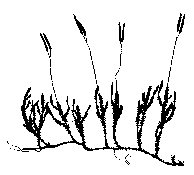 Descendants of these primitive plants (Lycopodium species) thrive as low evergreen ground cover in
wilderness forests, spreading by underground rootstocks to form small colonies. They derive their name from the reproductive "strobili," spike-like "clubs"
containing spores that protrude from the top of some of the 400 species of this flowerless plant. Including the strobili, the club mosses of our
era generally grow to only 3 to 16 inches tall, although they can branch for several feet along the ground, hence the common name ground pine.
Club mosses grow in damp places, including in the tropics and on temperate heaths and mountainsides. Some resemble creeping pine boughs, while
others look like miniature fir trees, although they are more closely related to the ferns. Their fine yellow spores, known as lycopodium powder,
have been used for fireworks and old-time camera flash powder.
Descendants of these primitive plants (Lycopodium species) thrive as low evergreen ground cover in
wilderness forests, spreading by underground rootstocks to form small colonies. They derive their name from the reproductive "strobili," spike-like "clubs"
containing spores that protrude from the top of some of the 400 species of this flowerless plant. Including the strobili, the club mosses of our
era generally grow to only 3 to 16 inches tall, although they can branch for several feet along the ground, hence the common name ground pine.
Club mosses grow in damp places, including in the tropics and on temperate heaths and mountainsides. Some resemble creeping pine boughs, while
others look like miniature fir trees, although they are more closely related to the ferns. Their fine yellow spores, known as lycopodium powder,
have been used for fireworks and old-time camera flash powder.

